Guide
What a cover-up covers: shade, the shadow rule, and the hours that actually matter
A cover-up covers your shoulders and whatever the hem reaches, while it is dry. Everything else about a beach day comes down to the hour, the shade and the parts of you the fabric never touches.
Published 6 September 2026 · 15 minute read · sources read 6 September 2026
Start with the piece
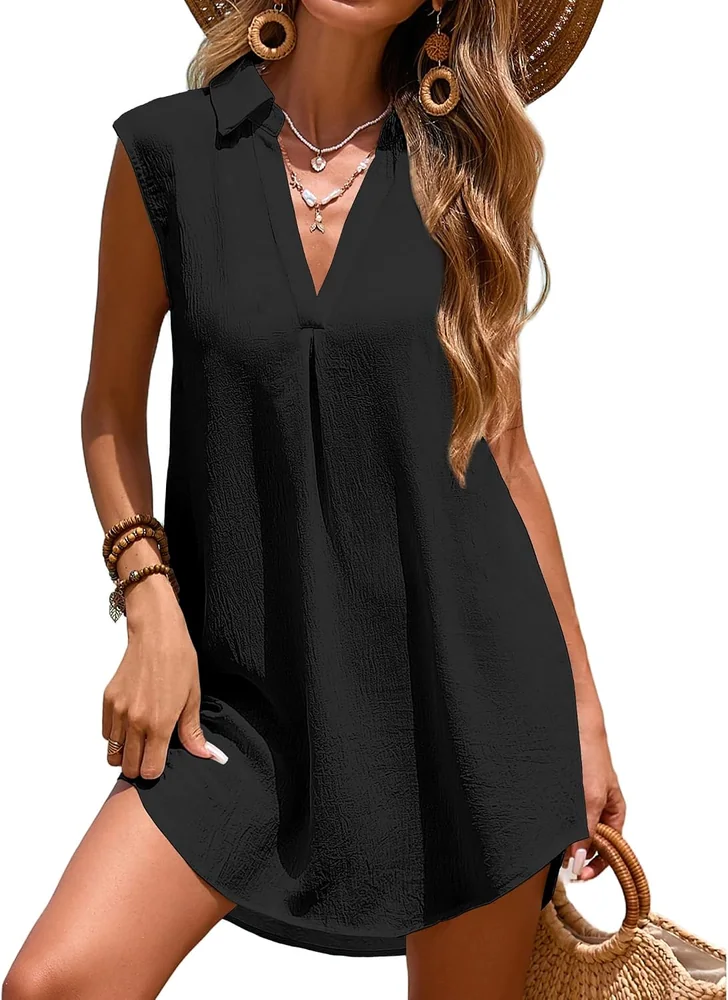
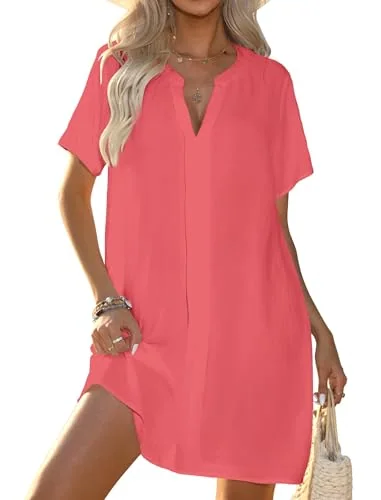
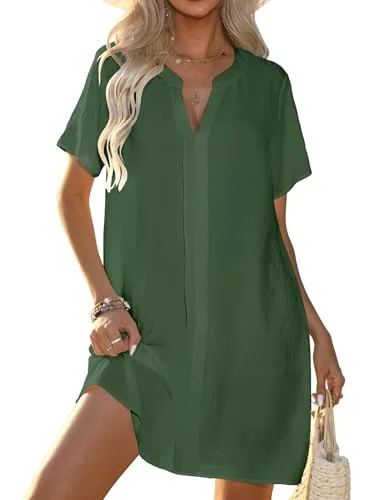
Halife cover-ups this guide is about
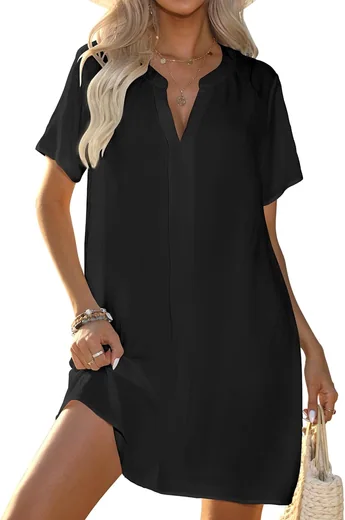
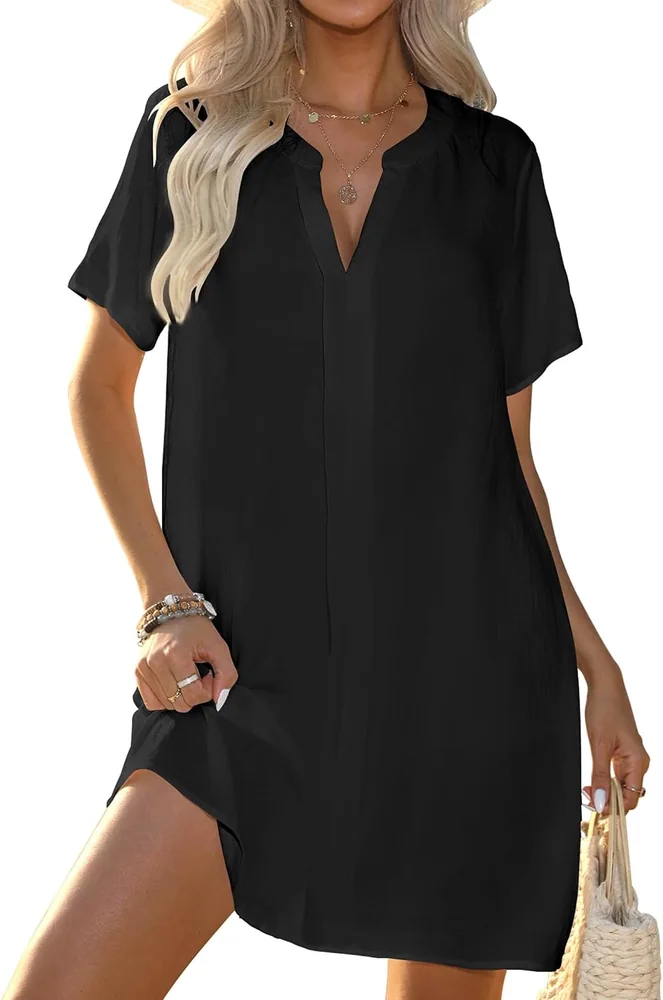
Short-Sleeve V-Neck Swim Cover-Up, Black
short sleeve · V neck · loose fit
4.1 out of 5 · 1,505 ratings
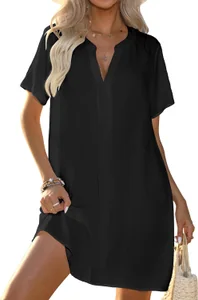
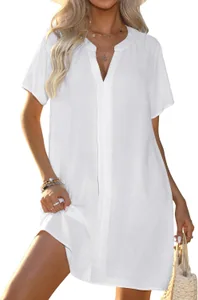
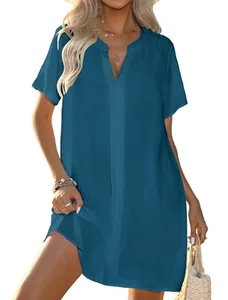
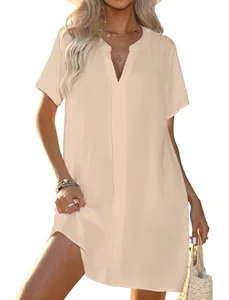
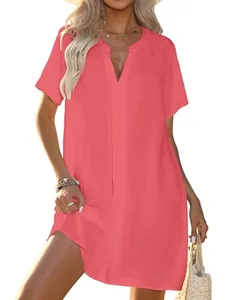
$19.99

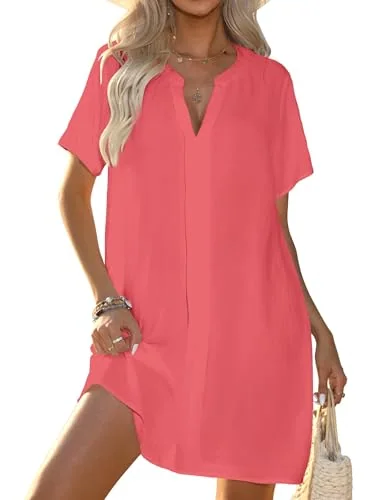
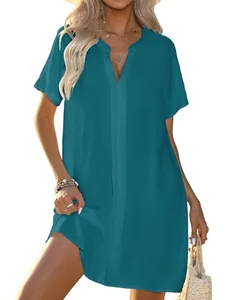
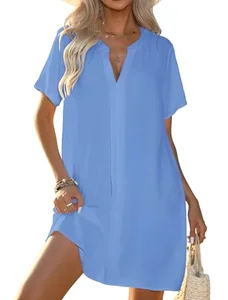
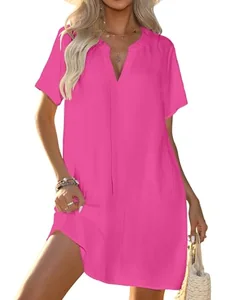
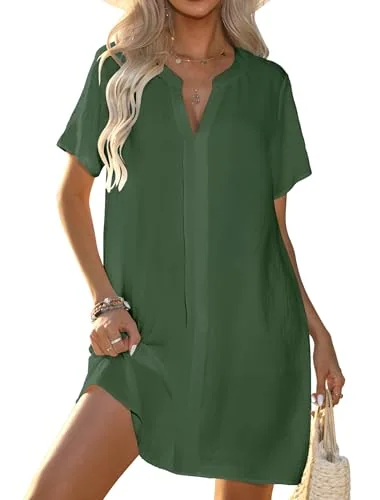
V-Neck Cover-Up Dress II, Army Green
V neck · loose fit
4.1 out of 5 · 1,505 ratings
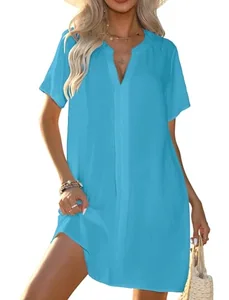
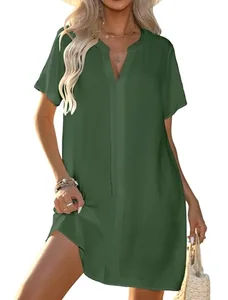
Size M only in this colour
$19.99
The shadow rule
There is one piece of sun advice worth carrying around, and it needs no app, no forecast and no reading. Look down.
If your shadow is taller than you are (in the early morning and late afternoon), your UV exposure is likely to be lower.
United States Environmental Protection Agency, UV Index Scale, read 6 September 2026
If your shadow is shorter than you are (around midday), you are being exposed to higher levels of UV radiation. Seek shade and protect your skin and eyes.
United States Environmental Protection Agency, UV Index Scale, read 6 September 2026
That is the whole of it. When your shadow is short, the sun is high, and the light is reaching you through the least atmosphere it will pass through all day. A short shadow at the beach is the signal to get under something, and a cover-up is the fastest something there is.
We work in Charleston, where this rule gets tested from April to October, and it is the reason the cover-up bench exists at all. What follows is what a cover-up actually does in that hour, what it does not do, and the four things that make the same piece of fabric cover less than it did yesterday.
What the index is telling you
The UV index is a forecast, in the same way a temperature is a forecast, and it sorts into bands. At the bottom of the scale the official guidance is unusually relaxed:
No protection needed. You can safely stay outside using minimal sun protection.
United States Environmental Protection Agency, UV Index Scale, read 6 September 2026
That band is 1 to 2, and in a Charleston July you will not see it between breakfast and dinner. Everything from 3 upward is the band where the guidance says protection is needed, and 8 and above is where it says extra protection is needed and asks you to be careful about the middle of the day specifically.
What this means for a wardrobe rather than a weather app: the decision about what to wear on a beach day is made by the hour, not by the temperature. A cool, breezy, overcast day in June can carry a higher index than a hot, still afternoon in September, and the breeze is what fools people because it removes the sensation of heat that normally makes them cover up.
Why an hour beats a fabric
There is an order of operations to sun protection, and every one of the public documents at the foot of this page puts it in the same sequence: shade first, then clothing, then a hat and sunglasses, then sunscreen on whatever is left. Clothing is second, ahead of the bottle, and it is second for a reason that has nothing to do with fabric technology.
A sleeve does not wear off. It does not need reapplying after ninety minutes, it does not wash away in the surf, it does not get missed in the awkward strip between the shoulder blades, and it does not depend on anyone applying the quantity the label assumes. A cover-up that stays on is doing more for you at four in the afternoon than a careful application of sunscreen at eleven.
But the hour beats both. The intensity of ultraviolet light at midday is several times what it is two hours either side, so moving the same activity earlier or later does more than any garment or bottle can. This is the least fashionable advice in sun protection and the most effective: swim at ten, eat at one, come back out at four.
The cover-up bench is built for the part of that plan people actually keep to, which is the middle. A cover-up that reaches the knee turns the hottest hour into lunch rather than a retreat.
A layer is not a rating
A UPF number is a laboratory measurement of one specific fabric, and it belongs on garments made and labelled for that purpose: rash guards, technical sun shirts, hiking layers. A cotton gauze cover-up is a different kind of garment, and it works the way ordinary clothing works.
Ordinary clothing does a great deal. Every piece of public guidance on sun safety puts covering skin ahead of sunscreen, not behind it. The Centers for Disease Control put it plainly:
When possible, wear long sleeves and long pants or skirts.
Centers for Disease Control and Prevention, Sun Safety Facts, read 6 September 2026
A cover-up is a short-sleeved version of that advice for a situation where long sleeves are unrealistic. It covers the shoulders, the upper back and the upper arms, which are the three places that burn first on a beach, and it does it without a bottle, without reapplication and without washing off in the water.
What it leaves out is everything below the hem, the forearms on a short sleeve, the chest above a V-neck, the ears, the nose and the tops of the feet. That is what sunscreen is for, and the two are not alternatives.
Wet, stretched, pale
The same cover-up does not cover the same amount all day. The dermatologists and the CDC agree on the mechanism, and the CDC states it in one line:
A wet T-shirt doesn't protect you as well as a dry one, and darker colors may protect more than lighter colors.
Centers for Disease Control and Prevention, Sun Safety Facts, read 6 September 2026
Four things change what a layer does, and all four are in your hands.
| What changes | Why it covers less | What to do about it |
|---|---|---|
| Wet | water fills the spaces in the weave and carries light through | let it dry, or carry a second layer |
| Stretched | the gaps open as the fabric pulls across the shoulders | a loose layer covers more than a tight one |
| Pale and thin | less yarn, less absorption | dark and dense covers more, per the dermatologists |
| Old and thin | years of sun and washing thin the yarns | an old favourite is a lighter layer than it used to be |
The one people miss is stretch. A cover-up bought a size too small pulls across the shoulders, the weave opens, and the part of the garment over the part of you that faces the sun is the part covering least. This is the practical reason every cover-up on this bench is cut generous, and why the size guidance for the bench is your usual size rather than a size down.
Weave and colour
Two properties of a fabric decide how much light gets through it: how densely it is woven and how dark it is. The American Academy of Dermatology is direct about the second one:
In addition, dark colors offer more protection than light colors.
American Academy of Dermatology, What to wear to protect your skin from the sun, read 6 September 2026
Density is the bigger of the two effects and the one you can judge yourself. A dense weave has less space between the yarns for light to pass through, and that is the entire mechanism: the fabric is either in the way or it is not.
Density you can test in ten seconds without any equipment: hold the fabric up to a lamp. A dense weave shows a faint glow. An open weave shows the shape of the bulb. Lace, loose gauze and open crochet, all of which look wonderful over a swimsuit, show the bulb clearly, and that is honest information about what they will do at noon.
Colour is a smaller effect than density but it runs the same direction, and on this bench it gives you a genuine choice: the darker pieces cover more, the paler ones run cooler in still air. On a windy beach the dark one is the better call because moving air removes the heat penalty. In still heat under a palm, the pale one is more comfortable and the shade is doing the work anyway.
There is a third property nobody mentions, and it is fit. A garment held away from the skin by its own cut keeps a layer of moving air between the fabric and you, so a loose cover-up feels cooler than a bare shoulder in the sun.
It also stops the fabric being stretched flat against the body, which is where the weave opens. Loose is cooler and covers more, and that is a rare case of the comfortable choice and the protective one being the same choice.
What none of this makes is a rating. A dense dark woven held away from the skin covers substantially more than an open pale knit pulled tight, and neither of them has a number on the label, and we are not going to invent one for either.
The parts people burn
Sunburn on a beach day is not random. It arrives in the same five places, in the same order, and a cover-up addresses exactly two of them.
The shoulders and the upper back. Straight up, facing the sun for the whole day, and the first place to go. A cover-up covers both, which is most of its value.
The chest above a neckline. Covered by a high neck, exposed by a V. If you are wearing a V-neck cover-up, that triangle is a sunscreen job.
The tops of the feet. Nothing in a wardrobe covers these on a beach and everyone forgets them.
The ears and the back of the neck. A cap does neither. The CDC is specific about what does:
For the most protection, wear a hat that has a brim all the way around that shades your face, your ears, and the back of your neck.
Centers for Disease Control and Prevention, Sun Safety Facts, read 6 September 2026
The parting in your hair. Also a hat problem, and also invisible until the evening.
There is an order to those five that is worth knowing, because it is the order in which a beach day goes wrong. The shoulders go first, in the first hour, while everyone is still arranging towels. The chest above a neckline goes second, usually during lunch, because a table faces the sky as squarely as a towel does. The feet go third, in the afternoon, and the ears and the parting are what you discover in the mirror that evening.
A cover-up put on at the start rather than at noon takes the first two off that list entirely, which is most of the value it will ever give you.
We do not sell hats and we are not about to start, but a guide about covering up that pretended a cover-up handles the whole job would be a bad guide.
Hats, shade and the hours
Shade is first in every one of these documents, ahead of both clothing and sunscreen, and it is the only intervention that works on all five of those places at once. The practical version for a beach day is to plan the day around the short shadow rather than fight it: water and sun in the morning, lunch and shade through the middle, back out when the shadows lengthen.
Shade is also less absolute than it sounds. Ultraviolet light scatters, bounces off water, off pale sand, off a white wall and off the underside of an umbrella, so sitting under a parasol on bright sand is not the same as sitting under a tree on grass. You get a meaningful reduction, not a wall. That is the argument for keeping the layer on even in the shade, which costs nothing on a breezy day.
The other thing worth knowing about a beach specifically: sand and water both reflect, so the light arrives from below as well as above. The parts of you that never burn on a city street, the underside of the chin and the inside of the arms, are exactly what catches it on a boat.
That planning is also what a good cover-up is for. The reason the longer shapes on this bench reach the knee is so the middle of the day can happen at a table rather than on a towel, without a change of clothes and without sitting through lunch in a wet swimsuit.
The bench, counted
The cover-up bench at the last update, by shape, so you know what exists before you filter. Counts are pages, so a shape that comes in more colours counts higher.
| Shape | Pages | What it does | Why it matters |
|---|---|---|---|
| Button-up | 55 | opens fully, nothing over wet hair | the most adjustable shape here |
| Short sleeve | 28 | covers the shoulder cap | the shoulders are what burn first |
| Sleeveless | 27 | covers the body, not the arms | arms need sunscreen |
| Longer shapes | 5 | reads as a dress off the sand | lunch without changing |
From the bench
Pieces this chapter is about
Short-Sleeve V-Neck Swim Cover-Up, Black
short sleeve · V neck · loose fit
4.1 out of 5 · 1,505 ratings
$19.99
V-Neck Cover-Up Dress II, Army Green
V neck · loose fit
4.1 out of 5 · 1,505 ratings
Size M only in this colour
$19.99
The filters on the bench page work on the facts in this guide: colour, size, sleeve and length. If you want the longest shapes, filter by length and start there.
Sizing on this bench is its own question, and a short one: take your usual size. These are cut generous on purpose, and a cover-up sized down stops doing the job. If you are between two sizes anywhere else on the site, the reasoning is in the sizing guide.
Where a cover-up crosses over into a dress, which the longer shapes do, the dresses bench is the place to keep looking. Several of the maxi shapes there work over a swimsuit as well as the dedicated cover-ups do, and they come in the lengths this bench does not carry.
Salt, chlorine and fabric
The thing that ends a cover-up is rarely the sun. It is salt and chlorine drying into the fibre and then being left in a bag until Tuesday.
Chlorine and salt work differently and both work slowly. Salt crystallises as the water evaporates, and the crystals sit in the weave as small hard edges that cut the yarn every time the fabric moves. Chlorine is a bleach, and a mild one keeps bleaching for as long as it is in the fibre, so a swimsuit left in a bag comes out paler than it went in.
Rinse in fresh water before it dries, wash cold within a day, hang in shade. A favourite piece fades in stripes where it was folded in a bag, and that is chlorine still working days later.
Do not wring a wet cover-up. Press the water out flat, because wringing a light woven at the shoulder is what leaves the pucker that never comes out.
The care guide on this site goes through the label rules in detail, including what a care label is legally obliged to tell you about water temperature and drying: reading a care label. For this bench the short version is: cold, rinsed, dried in shade.
One more thing that shortens the life of a cover-up faster than either salt or sun: sunscreen itself. The mineral filters in most modern formulations leave a stubborn mark on pale fabric, and the ones that do not stain still leave oils that hold dirt. A cover-up that goes on over freshly applied sunscreen every day for a week and then waits until Saturday for a wash comes out of that week permanently grey at the shoulders.
When clothing is not enough
This page is about clothes, and clothes are not medical advice. Nothing here has been reviewed by a clinician, and none of these pieces is a medical device or a rated protective garment.
There are people and days where a layer is a start and not an answer. A history of skin cancer, a medicine that raises sun sensitivity, a very young child, or a day on water at altitude where the light arrives from below as well as above. The three sources at the foot of this page are written for exactly those questions, and a dermatologist is the person to ask rather than a clothing brand.
A beach day, in order
- Check your shadow, not the thermometer. Short shadow means the middle of the day has arrived, whatever the temperature is doing.
- Put the cover-up on dry and loose. Your usual size. A layer that pulls across the shoulders is covering least where you need it most.
- Sunscreen on what the layer does not reach: forearms, the chest above the neckline, the tops of the feet, the ears, the parting.
- A brim all the way around rather than a cap, if the day is long.
- Move the middle hours into shade and let the longer cover-up handle lunch.
- Rinse it before it dries and wash it cold at home. Salt does more damage than sun.
Sources
- UV Index Scale, United States Environmental Protection Agency, read 6 September 2026.
- Sun Safety Facts, Centers for Disease Control and Prevention, read 6 September 2026.
- What to wear to protect your skin from the sun, American Academy of Dermatology, read 6 September 2026.
Before you go
More from cover-ups
V-Neck Cover-Up Shirt II, Navy Blue
V neck · loose fit
4.1 out of 5 · 1,505 ratings
Size XL only in this colour
$19.99